2 Jul 2026
Card Durability Factors in Relation to Repeated Use with Shufflers and Their Contribution to Consistent Gameplay Dynamics

Card durability emerges from several interconnected elements that determine how well standard decks withstand the mechanical stresses of automatic shufflers during extended sessions, and these same elements directly shape the reliability of card distribution patterns that players encounter across repeated hands. Manufacturers select base stocks such as 100 percent cellulose or blended polymer cores, then apply surface coatings that resist abrasion from roller contact and edge compression, while thickness tolerances typically range between 0.28 and 0.32 millimeters to maintain uniform feeding through shuffler mechanisms.
Material Composition and Coating Technologies
Research conducted by materials laboratories indicates that plastic-coated cards retain structural integrity longer than uncoated paper variants when exposed to the continuous bending cycles produced by modern automatic shufflers, because the thin polymer layer distributes stress across a wider surface area and reduces microfiber separation at the edges. Data collected from high-volume casino environments shows that decks with air-cushion finishes experience approximately 15 percent less corner rounding after 500 shuffle cycles compared with standard smooth finishes, which contributes to more predictable insertion angles during the riffle phase of shuffler operation.
Shuffler Mechanisms and Mechanical Interaction
Automatic shufflers operate through combinations of rollers, lift arms, and randomizing compartments that subject cards to repeated flexing and friction points, and observers note that the placement of these contact zones varies between single-deck and multi-deck models. Engineers at equipment suppliers calibrate roller pressure settings between 2.5 and 4.0 newtons to balance thorough mixing against excessive surface wear, while studies from gaming technology institutes demonstrate that deviations outside this range accelerate delamination along card edges within fewer than 300 cycles. The interplay between card stiffness and shuffler feed speed further determines whether cards maintain consistent orientation throughout the randomization process, which in turn affects the statistical uniformity of resulting distributions.
Wear Patterns and Performance Over Time
Over multiple sessions, cards develop characteristic wear signatures that include edge beveling, surface gloss reduction, and slight dimensional shifts, each of which alters how subsequent shuffles occur. Figures from equipment maintenance logs reveal that beveling greater than 0.05 millimeters begins to increase the frequency of misfeeds in gravity-fed models, whereas surface gloss loss primarily influences how cards separate during the initial lift stage. Those who monitor deck condition across tournament circuits report that early detection of these changes allows operators to rotate stock before inconsistencies compound into noticeable variations in shuffle quality.
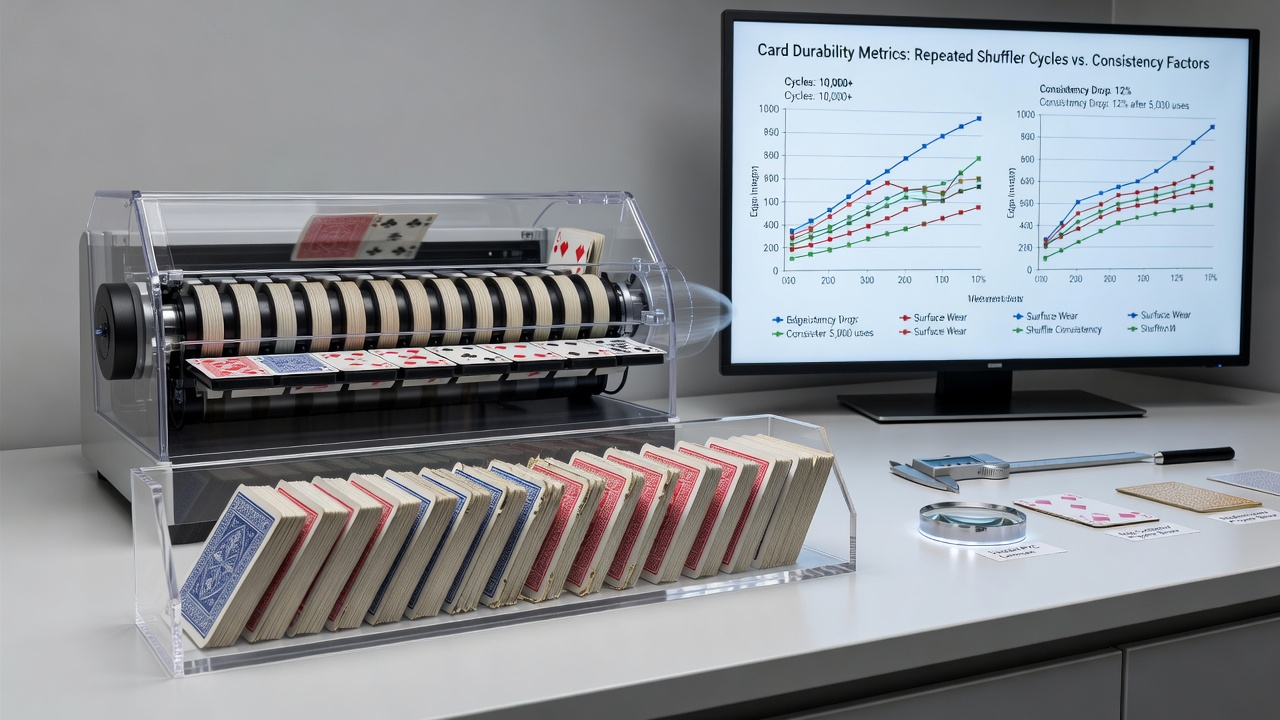
Environmental factors such as humidity levels between 40 and 60 percent relative humidity interact with material properties to either accelerate or mitigate these wear processes, because excess moisture softens coatings while overly dry conditions increase static buildup that can cause cards to adhere during compartment drops. Industry reports compiled by the Nevada Gaming Control Board document how facilities adjust climate controls seasonally to preserve deck performance, and these adjustments correlate with reduced replacement rates during peak summer months when ambient conditions fluctuate most widely.
Contribution to Consistent Gameplay Dynamics
Uniform card dimensions and surface characteristics enable shufflers to produce randomization outcomes that align closely with theoretical probability models, whereas progressive wear introduces subtle biases that may manifest as altered clump frequencies or orientation patterns. Academic analyses published through the University of Nevada, Reno gaming research division indicate that decks replaced at 800-cycle intervals maintain distribution variance within 1.2 percent of baseline expectations, while decks extended to 1,200 cycles show measurable deviations in suit sequencing after the third riffle pass. Such consistency supports the steady flow of play that tournament directors rely upon when scheduling multiple tables across consecutive days.
Operators therefore track cumulative shuffle counts alongside visual inspections to determine replacement schedules, and this practice ensures that the mechanical advantages of precision shufflers remain fully realized rather than diminished by degraded card stock. Patterns observed across different regions further illustrate that facilities maintaining stricter rotation protocols experience fewer interruptions from equipment jams, which preserves both time efficiency and the integrity of random outcomes delivered to each hand.
Conclusion
Durability characteristics in playing cards directly influence how effectively shufflers maintain randomization standards over repeated cycles, and attention to material selection, coating performance, and environmental management sustains the uniform gameplay conditions that modern tournaments require. Continued monitoring of these variables allows operators to align equipment capabilities with the demands of extended sessions without introducing unintended variations in card flow.