27 Jun 2026
Decoding Friction Dynamics Between Poker Cards and Felt Mats in High-Intensity Play Scenarios

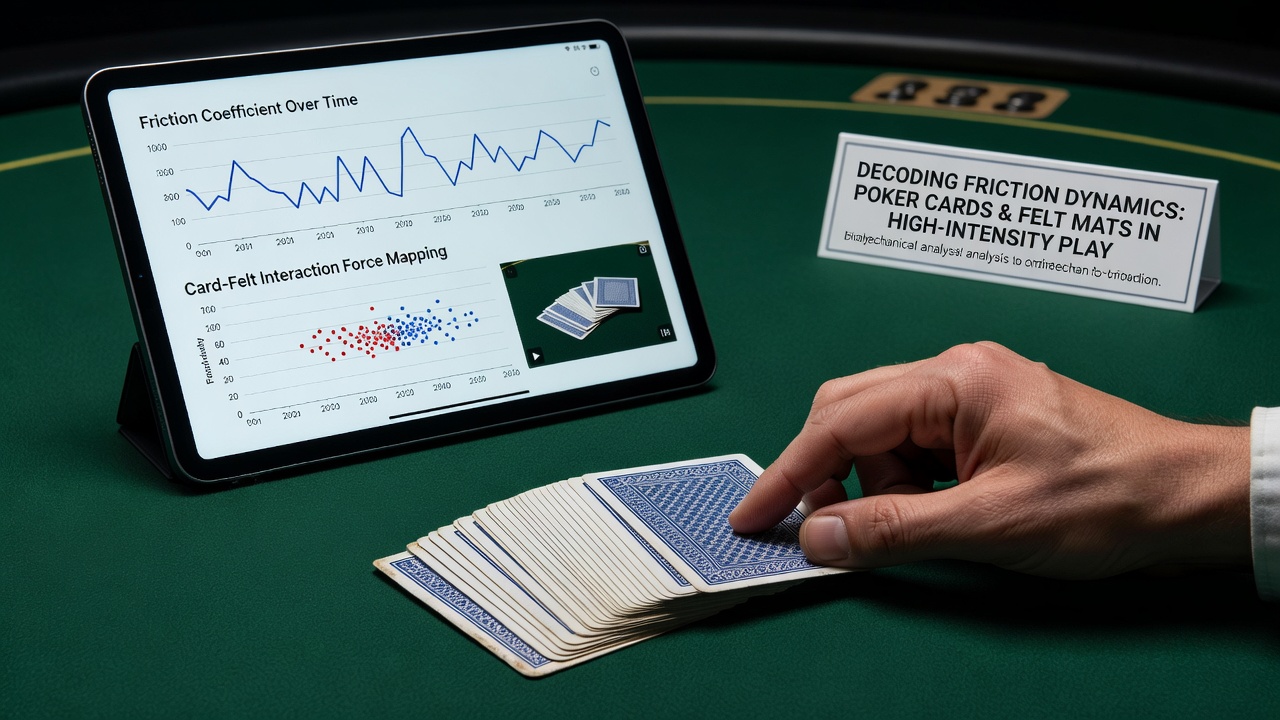
Friction between standard playing cards and felt table mats governs how smoothly cards travel during rapid dealing sequences, and this interaction becomes especially critical when tournament volumes spike. Research from materials testing labs shows that the coefficient of friction typically falls between 0.25 and 0.45 depending on felt density and card coating composition, which directly influences both card speed and dealer control across extended sessions.
Core Mechanics of Card-to-Mat Contact
Each card carries a thin polymer layer that meets the short fibers of the felt surface, creating microscopic contact points that generate resistance as the card slides forward. Observers note that higher fiber density in the mat increases surface area engagement, which raises friction yet also provides greater directional stability when dealers execute quick flips or spreads. Data collected during controlled lab simulations reveal that cards traveling at 1.2 meters per second experience measurable deceleration within the first 30 centimeters, and this deceleration scales with ambient humidity levels because moisture alters both fiber stiffness and coating tackiness.
Equipment technicians track these variables through high-speed cameras positioned above test tables, capturing frame-by-frame movement that allows precise calculation of kinetic versus static friction thresholds. Such measurements help manufacturers calibrate mat nap length and card edge bevels so that performance remains consistent even when play intensity rises during final tables.
Performance Under Tournament Conditions in June 2026
Events scheduled for June 2026 continue to push equipment limits as player fields expand and dealing rates climb above 35 hands per hour in many rooms. Tournament directors report that felt mats begin to show directional wear patterns after approximately 18 continuous hours of heavy use, with fibers flattening along the primary dealing axis and thereby lowering local friction coefficients by up to 12 percent. Cards, meanwhile, accumulate micro-abrasions along their edges that increase surface roughness and can elevate friction once the original coating begins to degrade.
These gradual changes alter the rhythm of play because dealers unconsciously adjust push force and release angle to compensate for shifting resistance. Studies conducted at university engineering departments confirm that even small friction drift affects card flight trajectory, particularly when players request burns or when community cards must land precisely within marked betting lines.
Material Variables That Shape Outcomes
Felt composition typically blends wool and synthetic fibers in ratios that balance durability against desired slide characteristics, while cards rely on multiple layers of paper stock sealed with UV-cured varnishes. Researchers have documented that increasing the synthetic content in felt raises baseline friction yet extends service life by roughly 25 percent under continuous tournament conditions. Conversely, cards finished with higher-gloss coatings reduce initial resistance but show faster wear once surface layers thin, leading to unpredictable glide behavior after several hundred hands.
Temperature also plays a measurable role because both felt fibers and card coatings expand or contract at different rates. Facilities located in warmer climates often record slightly lower friction readings during afternoon sessions compared with morning play, a pattern attributed to thermal softening of polymer surfaces. Maintenance crews therefore rotate mats on fixed schedules and inspect card decks for edge wear to keep these variables within acceptable operational windows.
Measurement Protocols and Industry Standards
Standardized testing procedures outlined by the International Gaming Standards Association specify the use of inclined-plane rigs and digital force sensors to quantify static and kinetic friction at multiple points across a mat surface. These protocols require sampling at least nine locations per mat to account for manufacturing variations and localized wear. Results feed directly into certification processes that many regulatory bodies reference when approving equipment for licensed venues.
Additional data collected through field studies at major properties demonstrate that consistent friction values correlate with fewer misdeals and smoother game flow during peak hours. Technicians apply these findings when selecting replacement mats or when evaluating new card stock batches before they enter circulation.
Practical Adjustments Observed in Active Play
Dealers adapt their techniques once friction begins to shift, often shortening the push distance or altering wrist angle to maintain card control. Floor supervisors monitor these adaptations because they can signal when equipment rotation is advisable. Venues that track cumulative hand counts alongside periodic friction audits report more stable dealing performance across multi-day events, reducing the need for mid-tournament equipment swaps.
Supply chain managers coordinate with producers to ensure that replacement components maintain the same friction profiles as original installations, thereby preserving continuity for players who develop tactile expectations during long sessions. This coordination becomes especially relevant when regional climate differences affect fiber behavior and coating adhesion over time.
Conclusion
Friction dynamics between cards and felt mats represent a measurable system shaped by material properties, environmental conditions, and usage intensity. Ongoing data collection from both laboratory and tournament settings continues to refine equipment specifications, helping venues maintain consistent performance even as play volumes increase throughout 2026. Understanding these interactions allows manufacturers and operators to select components that preserve reliable card movement across extended high-intensity scenarios.