23 Jul 2026
How Accessory Pairings Shape Session Flow in Multi-Table Poker Environments with Different Player Numbers

Multi-table poker operations rely on coordinated accessory selections that directly affect how quickly hands progress and how players move between tables, and these effects become more pronounced as participant numbers shift from small groups of twenty or thirty to fields exceeding two hundred. Observers note that the combination of automated shufflers with specific mat surfaces alters the interval between hands, while chip tray designs and dice sets used for side resolutions introduce additional timing variables that scale differently across player counts.
Core Factors in Accessory Compatibility
Equipment pairings determine the baseline rhythm of each table because shuffler mechanisms interact with mat textures to control card return and redeal times, and these interactions change when tables operate at full nine-player capacity versus six-player configurations. Research from equipment compatibility studies indicates that certain felt compositions reduce friction during card slides, allowing shufflers to complete cycles in under five seconds on average, whereas rougher surfaces extend that window by several seconds per hand. In setups where multiple tables run simultaneously, even small per-hand delays accumulate across dozens of tables and hundreds of players.
Chip case designs further influence movement patterns because standardized racks that match table edge heights permit faster dealer reaches and fewer misplacements during chip pushes. Data collected during high-volume events shows that mismatched chip capacities force dealers to pause for restocking more frequently when player counts rise above one hundred and fifty, creating bottlenecks at specific tables that then affect overall session progression.
Impact Across Player Count Thresholds
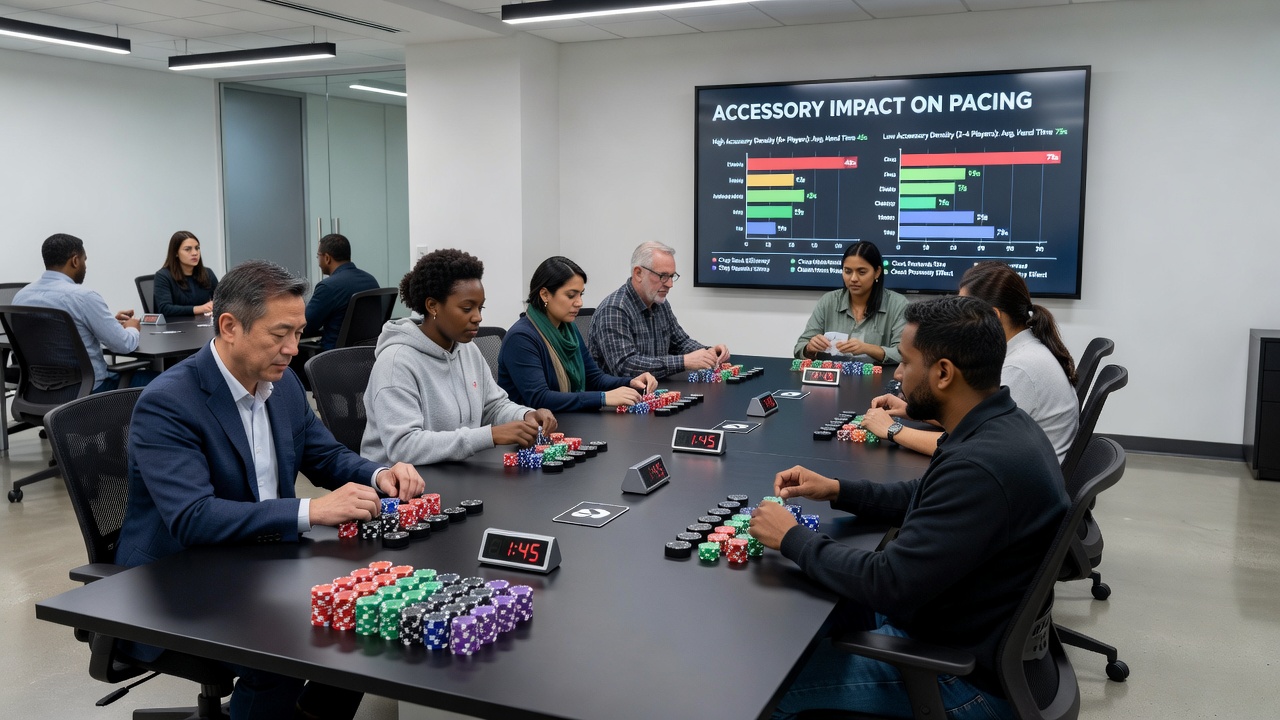
At lower player counts under fifty total participants, accessory pairings exert less cumulative pressure on pacing because fewer tables operate in parallel and staff can intervene quickly when timing slips occur. Yet as fields expand into the one hundred to two hundred range, the same pairings produce measurable differences in average hands per hour, with coordinated shuffler and mat sets maintaining steadier throughput compared to mixed equipment configurations. July 2026 tournament schedules demonstrated these patterns clearly during multi-day structures where organizers tracked hand completion rates across sections divided by table density.
Higher player volumes also amplify the role of dice and ancillary resolution tools because side bets or tiebreakers occur more often when more hands run concurrently, and the physical placement of dice trays relative to shuffler units determines whether dealers can resolve disputes without standing or reaching across active play areas. Studies on workflow efficiency reveal that integrated dice storage within chip cases cuts resolution time by measurable margins once participant numbers exceed one hundred and twenty per session.
Equipment Scaling and Flow Optimization
Operators adjust accessory combinations based on projected table density because nine-player tables require larger mat surfaces and higher-capacity shufflers than six-player formats, and these differences affect how quickly empty seats refill after eliminations. When pairings remain consistent across all tables, movement between sections stays predictable even as total player numbers fluctuate throughout an event day. Reports from the Nevada Gaming Control Board highlight how standardized accessory protocols in large-scale operations correlate with reduced variance in session completion times.
Additional considerations emerge when card cases and protective covers enter the pairing equation, since quick-access storage solutions minimize the time spent swapping decks between tables and prevent delays that compound when multiple tables require simultaneous deck changes. Research indicates that these storage pairings become particularly relevant once player counts push past one hundred and seventy-five, where the frequency of deck rotations increases proportionally.
Regional Standards and Equipment Integration
Manufacturing variations across regions influence how accessories interact within multi-table environments, and data from international gaming equipment assessments shows that alignment between mat thickness, shuffler feed mechanisms, and chip edge profiles produces more consistent pacing than ad-hoc combinations. Australian regulatory reviews of tournament equipment, for instance, document how regionally sourced mats paired with imported shuffler units maintain hand rates within narrow tolerances even under varying humidity conditions that affect felt performance.
Those who manage large events track these integration details because small incompatibilities at individual tables create ripple effects that extend overall session duration when player numbers reach several hundred. Consistent accessory sets across all tables therefore support smoother transitions during breaks and table consolidations that occur naturally as fields shrink.
Conclusion
Accessory pairings establish the operational tempo of multi-table poker sessions by governing the speed of individual hand cycles and the efficiency of transitions between tables, with these effects scaling according to total participant numbers. Data from equipment compatibility analyses and regulatory tracking confirm that matched shufflers, mats, chip systems, and resolution tools maintain steadier pacing across both small and large fields, while mismatched sets introduce accumulating delays once operations exceed certain table thresholds. Event organizers continue to refine these combinations based on observed performance metrics gathered during peak periods such as the July 2026 schedule.