1 Aug 2026
The manufacturing tolerances linking dice balance, card stock weight, and chip edge profiles in coordinated poker kits
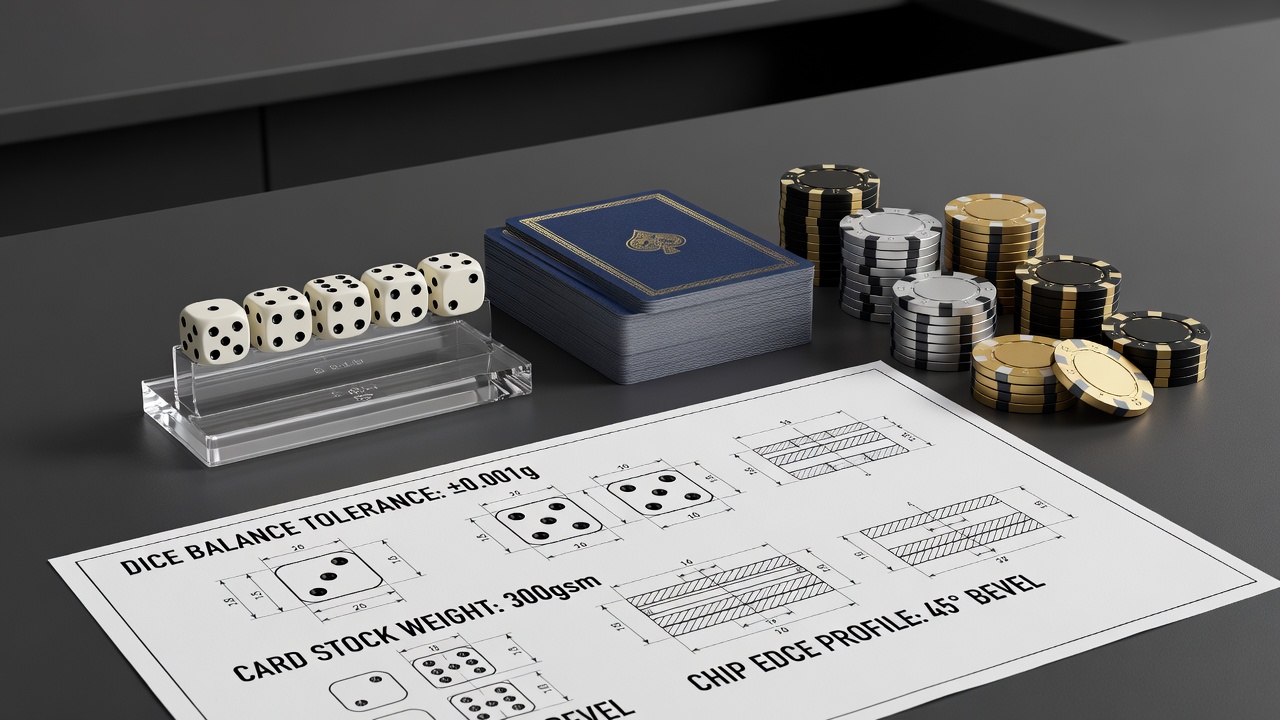 Manufacturing facilities maintain strict tolerances across dice, cards, and chips so that complete poker kits perform consistently in both casino and home environments, and these specifications connect directly through shared engineering requirements for balance, weight distribution, and surface interaction. Dice balance depends on uniform material density and precise pip placement, while card stock weight influences shuffle resistance and deck height, and chip edge profiles determine stack stability and handling friction.
Dice balance specifications and their production controls
Precision dice achieve balance when the center of mass sits within 0.02 millimeters of the geometric center, a standard enforced through multiple-axis weighing stations during production runs. Manufacturers remove micro-amounts of material from over-dense faces and verify results with computerized tomography scans before final polishing. Data from the Nevada Gaming Control Board shows that approved dice maintain this tolerance across batches of 10,000 units, reducing deviation in roll outcomes to levels consistent with theoretical probability models.
Material selection plays a central role here because acrylic cores must cure at controlled temperatures to avoid internal stress gradients that later affect balance after repeated impacts. Edge bevels receive laser measurement to ensure each corner matches within 0.01 millimeters, which prevents preferential rolling on certain faces. Observers note that these controls become especially relevant when dice appear in coordinated kits alongside other components whose physical properties must align during storage and transport.
Card stock weight parameters and interaction effects
Professional card stock typically weighs between 300 and 310 grams per square meter, with thickness held to plus or minus 0.015 millimeters across each sheet. This narrow range ensures that a standard 52-card deck maintains a predictable height of 15.8 to 16.2 millimeters when compressed under uniform pressure, allowing automatic shufflers calibrated for kit use to operate without jamming. Production lines monitor humidity during coating application because moisture absorption can shift effective weight by up to 2 percent and alter friction coefficients during dealing.
Research conducted at the University of Nevada, Reno, on multi-component gaming sets found that card weight variations above 5 grams per deck correlate with measurable changes in how dice settle after being rolled across the same surface, since the overall kit packaging must accommodate both items without movement during shipping. Coordinated manufacturers therefore adjust card caliper tolerances when dice specifications change between production lots.

Chip edge profile tolerances and stacking dynamics
Chip edge profiles incorporate a series of grooves and ridges machined to depths between 0.25 and 0.35 millimeters, with angular tolerances of 0.5 degrees to guarantee secure nesting when chips form stacks of twenty or more units. Injection-molding equipment holds these dimensions through real-time sensor feedback that adjusts cavity pressure every 0.3 seconds during each cycle. Edge roundness at the top and bottom surfaces stays within 0.08 millimeters to minimize catching when players slide chips across felt or speed cloth surfaces included in the same kit.
These profile specifications connect to dice and card requirements because the overall kit case must accommodate the combined volume and weight distribution of all three items without internal shifting. When chip edges exceed tolerance on the high side, the added bulk forces tighter compression on card decks stored alongside them, which can increase effective card stock weight pressure and introduce micro-abrasions that affect later shuffle performance. Production planners therefore run integrated tolerance stack-up analyses before releasing new coordinated kits.
Integrated tolerance management across kit components
Facilities producing complete poker kits apply statistical process control across all three product lines simultaneously, tracking how small deviations in one component propagate to the others. For example, a 0.03-millimeter increase in dice pip depth may require a corresponding adjustment in card stock thickness to keep the total packaged weight under shipping limits while preserving balance characteristics. August 2026 production schedules at several Asian and North American plants incorporated updated laser-scanning protocols that reduced cross-component variance by an additional 12 percent compared with 2025 baselines.
Industry reports indicate that these coordinated controls support regulatory compliance in multiple jurisdictions where gaming equipment undergoes third-party verification before distribution. The resulting kits demonstrate consistent performance metrics whether used in high-volume tournament settings or smaller private games, because the manufacturing tolerances were developed with full-system interaction in mind rather than isolated component specifications.
Conclusion
Coordinated poker kit manufacturing relies on interconnected tolerances that link dice balance, card stock weight, and chip edge profiles through shared measurement systems and statistical oversight. These controls ensure that the final assembled product meets performance expectations across diverse playing conditions while remaining compatible with packaging, storage, and regulatory requirements worldwide.